{{ p.title }}
{{ p.desc }}
{{ p.fee }}
{{ p.cta }}
Validation provides an external academic framework for the programme and supports the academic structure, quality processes and standards under the partnership. Programmes follow a European credit structure (ECTS) consistent with European Higher Education Area (EHEA) standards.
The Bachelor of Arts (B.A.) in Vaishnava Theology is a comprehensive undergraduate programme providing systematic, academically rigorous and spiritually grounded study of the theology, philosophy, literature, history and culture of the Gaudiya Vaishnava tradition.
The programme bridges the traditional gurukula model of scriptural learning with contemporary university-level higher education. Rooted in the theological heritage of Śrī Caitanya Mahāprabhu and the Gosvāmī tradition, it develops scriptural literacy, philosophical understanding, theological reasoning, cultural awareness and academic skills for further study and service.
The B.A. in Vaishnava Theology is offered through Vedavarsity and is validated by European International University (EIU–Paris) under the established institutional partnership and programme validation framework. The programme comprises 180 ECTS credits over six semesters and is structured as a three-year undergraduate degree.
What does validation mean? Validation provides an external academic framework for the programme and supports the academic structure, quality processes and standards under the partnership.
The Vaishnava tradition represents one of the major theological and philosophical traditions of India, with a rich body of Sanskrit and vernacular literature spanning theology, philosophy, devotional practice, aesthetics, ethics, history and sacred culture.
This programme provides a systematic undergraduate pathway for students who wish to study this tradition beyond informal or introductory scriptural classes. Students engage with major theological and scriptural works while developing the ability to read, interpret, analyse and communicate theological ideas in an academic context.
The B.A. in Vaishnava Theology is delivered 100% online, making the programme accessible to students regardless of geographical location.
Students participate in weekly live lectures, creating regular interaction with faculty and fellow students while maintaining the flexibility of online learning.
The total programme fee is €2,500. Students may choose between:
Apply NowThe programme is text-centred and tradition-based, with substantial engagement with primary theological and scriptural works. Students encounter:
The curriculum deliberately distinguishes the undergraduate programme from the M.A. in Vaishnava Theology, with the B.A. focusing on foundational theological education, scriptural literacy, philosophical training, cultural understanding and preparation for postgraduate study.
The programme combines structured teaching with independent academic engagement. Learning methods include:
The online format allows students to combine weekly live learning with guided and independent study.
The programme is particularly suited to learners seeking a systematic academic understanding of Vaishnava theology and its intellectual and cultural traditions. It is relevant for students interested in:
The programme is designed as an undergraduate pathway toward advanced theological specialization at master's and doctoral levels.
The exact eligibility for admission to any subsequent degree will depend on the receiving institution and its admission requirements.
The curriculum specifically differentiates the B.A. from the M.A. by positioning the B.A. as the foundational undergraduate pathway and the M.A. as the advanced specialization.
The programme is structured as a three-year undergraduate degree comprising 180 ECTS credits. The 180-ECTS structure is stated in the curriculum as consistent with EHEA standards.
{{ f.a }}
Vedavarsity is part of In Service of Srimad Bhagavatam, an initiative dedicated to reviving, sharing and living the wisdom of Sanatana Dharma. Rooted in the teachings of Srila Prabhupada and the Gaudiya Vaishnava tradition, it offers structured, scripture-based courses that guide students from foundational learning to advanced study.
Through live classes, self-paced modules and guided study, Vedavarsity serves a global community of students in Bhakti Yoga, scriptural study, Sanskrit, family life and Vedic lifestyle, taught by experienced devotees and scholars.
theology.vedavarsity.com brings this work into formal higher education: undergraduate and postgraduate degrees in Vaishnava Theology, and professional certificates in Dharmic Leadership and Management.
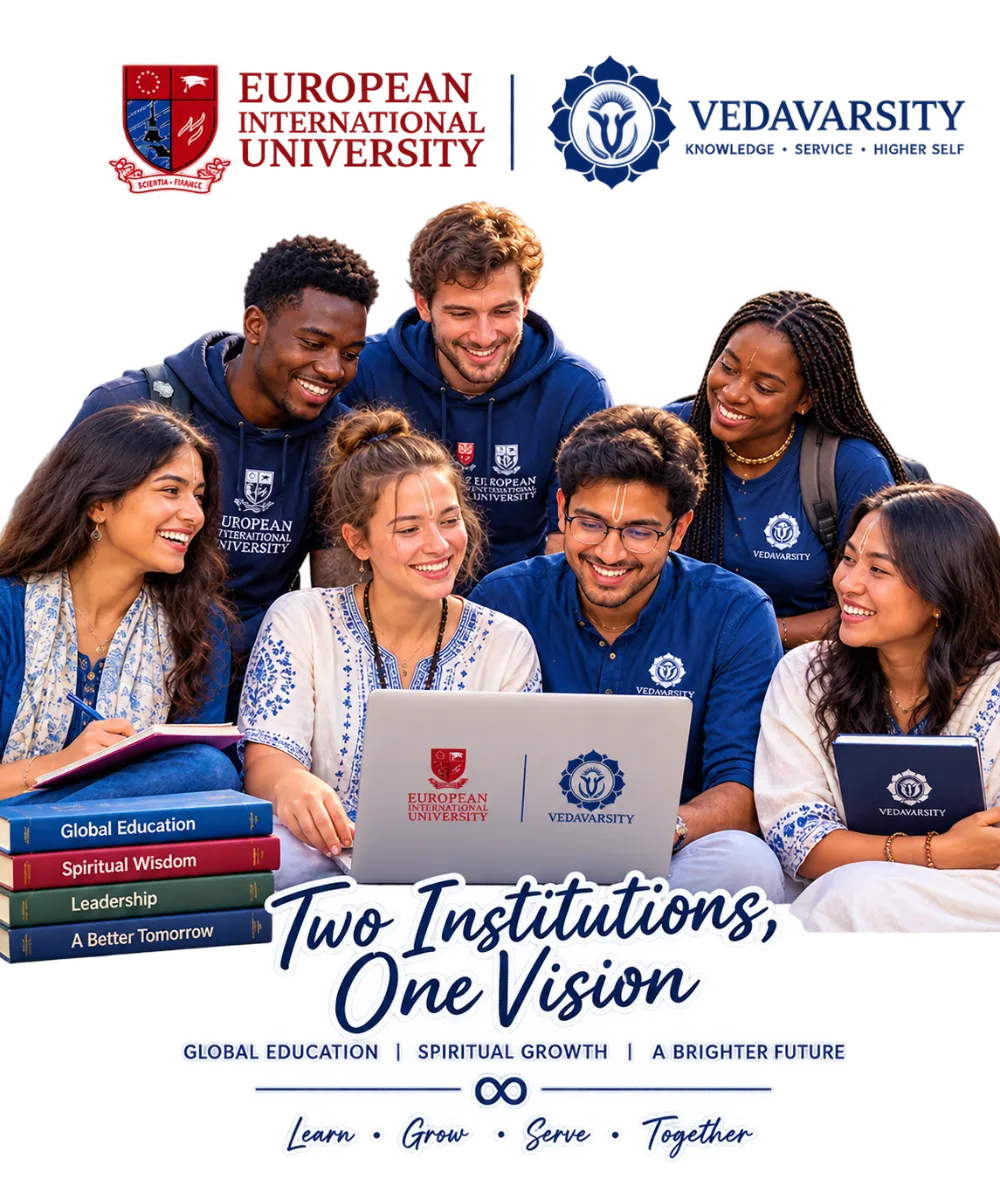
Our degree programmes are offered through Vedavarsity and validated by European International University (EIU–Paris) under an institutional partnership and programme validation framework.
The partnership brings traditional gurukula-style scriptural learning together with a European credit structure (ECTS), defined learning outcomes and quality processes consistent with European Higher Education Area (EHEA) standards.
The Master of Arts (M.A.) in Vaishnava Theology is an advanced postgraduate programme providing rigorous study of Gaudiya Vaishnava theology, scripture, philosophy, history, hermeneutics, Sanskrit textual studies, research methodology, pastoral care, leadership and applied theological practice.
Designed as a two-year intensive programme comprising 120 ECTS credits, the M.A. moves beyond foundational scriptural education into advanced theological interpretation, research, professional formation and practical application.
Rooted in the theological heritage of the Gaudiya Vaishnava tradition, the programme brings together traditional scriptural learning with contemporary postgraduate academic methodology.
Students engage deeply with major primary texts including Śrīmad Bhāgavatam, Caitanya Caritāmṛta, Madhurya Kadambini and other classical Vaishnava theological literature, while developing skills in theological research, hermeneutics, academic writing, pastoral care, education, institutional governance and leadership.
The M.A. in Vaishnava Theology is offered through Vedavarsity within the academic partnership framework with European International University (EIU–Paris). The programme follows a structured 120-ECTS postgraduate framework, comprising four semesters over two academic years.
The academic framework is designed around postgraduate-level theological study, research, academic writing, practical ministry formation and professional leadership.
The M.A. in Vaishnava Theology is an advanced postgraduate academic programme designed to provide rigorous theological, philosophical, historical and ministerial training within the Gaudiya Vaishnava tradition.
The programme responds to the need for academically trained Vaishnava scholars, educators, researchers, counselors, administrators and leaders who can engage with higher education, pastoral leadership, interreligious dialogue, institutional governance, scriptural interpretation and contemporary social engagement.
The programme is designed to bring together traditional paramparā-based theological learning, critical academic inquiry, international postgraduate standards and professional ministerial formation.
The Gaudiya Vaishnava tradition possesses a substantial theological and philosophical heritage expressed through Sanskrit, Bengali and other classical literary traditions.
The M.A. programme provides an opportunity to move from systematic scriptural study toward advanced theological interpretation, research and application.
The programme therefore connects scriptural scholarship with theological reasoning, research and practical service.
The total programme fee is £3,500. Students may choose between:
Apply Now{{ s.d }}
The programme is centred on advanced engagement with primary theological and scriptural literature. Students study:
The Master's Thesis is a central component of the M.A. programme. The expected dissertation length is approximately:
Students may undertake research in areas including:
The thesis functions as the capstone research project of the programme.
Research is positioned at the centre of theological maturity within the programme. Students are trained to:
The programme's research framework prepares students for advanced academic work and potential doctoral progression.
The programme's pedagogical framework combines lectures, seminars, Sanskrit tutorials, oral presentations, research colloquia, practicum, reflective journals and field immersion.
The programme uses a multidimensional assessment structure designed to evaluate theological knowledge, analytical reasoning, research competency and practical application.
The assessment framework therefore extends beyond written examinations to include research, oral articulation, textual analysis and practical engagement.
The M.A. in Vaishnava Theology is particularly suited to learners who wish to pursue advanced study and professional formation in Vaishnava theology and related fields. It is relevant for students interested in:
The accreditation proposal specifically positions the B.A. as foundational theological education and the M.A. as professional theological formation involving advanced texts, research methodology, pedagogy, governance and counseling.
The curriculum states that one ECTS represents approximately 25–30 hours of total student learning engagement, including lectures, seminars, guided reading, assignments, tutorials, fieldwork, examinations, research activities and independent study.
The programme has been designed within an international postgraduate academic framework and is aligned in the curriculum documents with:
The 120-ECTS structure is intended to support international academic comparability, student mobility and doctoral progression opportunities.
{{ f.a }}
{{ cert.desc }}
Each certificate is €250. Take any certificate individually, or build cumulatively and complete all eight as the full programme (€2,000). Select a certificate to view its full curriculum.
The Certificate Programmes in Dharmic Leadership and Management provide a structured professional education pathway integrating the Indian Knowledge System with contemporary leadership, management, governance, entrepreneurship, sustainability and organizational practice.
The curriculum draws upon the conceptual foundations of Śāstra, Artha, Dharma, governance and leadership, connecting traditional frameworks with modern professional education.
The pathway consists of eight stackable certificate programmes, each carrying 6 ECTS credits.
The curriculum integrates the Indian Knowledge System (IKS) into modern professional education by connecting traditional concepts of purposeful wealth, disciplined knowledge, governance, leadership and social welfare with contemporary organizational challenges.
The programme moves beyond purely transactional approaches to management and introduces a framework that considers:
The curriculum uses the Arthaśāstra tradition and related Dharmic concepts to explore leadership, governance and responsible professional practice.
The curriculum is designed to connect conceptual study with practical professional application.
The curriculum draws upon several conceptual foundations of the Indian Knowledge System.
The curriculum also introduces the Saptāṅga Rājya Framework, relating classical elements of governance to modern organizational structures.
The complete pathway therefore provides 48 ECTS credits across eight certificates.
The programmes are designed for learners and professionals interested in:
Because the certificates are stackable, learners may pursue individual areas of interest or progressively build toward the larger Diploma pathway.
This progression provides an integrated curriculum spanning individual leadership, organizational management, governance, enterprise, social responsibility and reflective leadership.
{{ f.a }}
Your application for {{ f.programme }} has been received. Our admissions team will contact you by email and WhatsApp with next steps.
Back to programme Chat with us